CBD itself is not a controlled drug, so yes, CBD products can be sold legally in the UK. But “legal CBD” is a much narrower category than the shelves of most CBD shops suggest.
Four different regulators police four different product types, and the rule everyone quotes, that under 0.2% THC is legal, is not a rule about products at all.
The short version
- 0.2% is not a product limit. It is the THC ceiling for the seed a licensed farmer may plant. It says nothing about what is on a shelf.
- The real test is one milligram of controlled drug per component part, plus two other conditions. That is a weight, not a percentage.
- UK ingestible CBD products must appear on the FSA public list.
- “Validated” on the FDA list does not mean authorised. As of yet, No CBD extract has ever been authorised as a novel food in Great Britain.
- The recommended daily intake was cut from 70mg to 10mg a day in October 2023, an 86% reduction.
- A health claim can turn any CBD products cannot make health claims. Doing so would turn it into an unlicensed medicine, whatever category it started in.
Four products, four sets of rules
The first thing to understand is that “is CBD legal” has no single answer, because a CBD oil, a CBD balm, a CBD vape and CBD flower are governed by four different regimes and four different regulators.
| Product | Governed as | Regulator |
|---|---|---|
| Oils, capsules, gummies, drinks | Novel food | FSA and Trading Standards |
| Creams, balms, cosmetics | Cosmetic product | OPSS and Trading Standards |
| Vapes | Vaping product | MHRA and Trading Standards |
| Flower and pre-rolls | Controlled drug | Home Office and police |
| Anything making a health claim | Medicine | MHRA |
That last row overrides all the others. A cream that claims to treat eczema stops being a cosmetic and becomes an unlicensed medicine, regardless of what it is made of.
Where the 0.2% figure really comes from
You will see 0.2% on packaging, on websites and in trade press, always presented as the legal limit. It is a real figure from a real instrument, and it means something completely different from what people think.
It is the maximum THC content of the seed varieties a farmer may sow under a Home Office industrial hemp cultivation licence. The figure appears in regulation 2(2)(a) of SI 2010/2497, and it exists to set the licence fee tier.
It is a rule about a plant growing in a field. It is tested on the standing crop. It has no application whatsoever to a bottle of oil or a bag of anything in a shop. There is no statutory THC percentage that makes a retail product lawful, because percentage is not the test the law uses.
There is a live proposal to raise the cultivation figure from 0.2% to 0.3%, recommended by the Advisory Council on the Misuse of Drugs in October 2024 and accepted in principle by the government in February 2025. Home Office guidance still said 0.2% as of its December 2025 update, so treat 0.2% as the current cultivation figure and check before relying on it.
The test that actually applies
For a finished product, the question is whether it is an “exempt product” under regulation 2 of the Misuse of Drugs Regulations 2001. All three of these must be true:
- The product is not designed for administering the controlled drug to a person or animal.
- The controlled drug cannot be recovered from it by readily applicable means, or only in a yield too small to risk health.
- No single component part contains more than one milligram of the controlled drug.
The third condition is an absolute weight. This matters more than it sounds. Take a 30ml bottle of full spectrum oil advertised at “under 0.2% THC”. Two tenths of one percent of 30ml is around 60 milligrams. That is sixty times the threshold, in a product whose percentage claim is entirely accurate.
So percentage and legality are answering different questions. A small concentrated product can pass. A large dilute one can fail. If a supplier can only tell you the percentage, they have not told you what you need to know.
Novel foods and the FSA list
Anything you swallow is separately caught by novel food law. In the UK CBD extracts and isolates are novel foods, which means they cannot lawfully be sold in food without authorisation, and as of yet no CBD extract has ever been authorised in Great Britain.
What exists instead is a transitional arrangement. The FSA maintains a public list of UK products that were on the market on 13 February 2020 and had an application submitted by 31 March 2021. Those products may stay on sale while their applications are considered.
“Validated” on that list means an application passed a completeness check. The FSA is explicit that validation is not authorisation and there is no guarantee a validated application will be authorised.
Only two things escape novel food status: hemp seed and its direct derivatives such as seed oil, and water infusions of hemp leaf. Anything derived from the flower is novel food.
The daily limit changed, and most labels have not
When the FSA first issued CBD advice in February 2020 it suggested a maximum of 70mg a day. On 12 October 2023 that was revised down to a provisional acceptable daily intake of 0.15mg per kilogram of body weight, which works out at 10mg a day for a 70kg adult.
That is an 86% reduction, driven by evidence about liver injury from sustained high intake. The FSA also set a daily limit of 0.07mg of THC from hemp-derived foods.
CBD flower, and why it is the hard one
This is the part of the trade that most shops treat as settled and that is not settled at all.
As covered in our article on the law itself, section 37 of the Misuse of Drugs Act 1971 defines cannabis by plant part. Mature stalk, fibre from mature stalk and seed are outside the definition. Everything else, including the flowering tops and leaves, is a controlled drug.
THC content does not enter into it. A cultivation licence does not help either: Home Office guidance is explicit that the flowers and leaves remain controlled under the licence, cannot be used, and must be destroyed. The licence covers seed and fibre.
On the plain wording of the Act, selling dried CBD or hemp flower is supply of a Class B controlled drug. The usual arguments, that it is a novelty item, that it is from an EU-approved low-THC cultivar, that it is hemp and not marijuana, do not change the statutory definition. This is widely sold in the UK and that does not make it lawful.
The words that turn a product into a medicine
Under regulation 2 of the Human Medicines Regulations 2012, something is a medicinal product if it is presented as having properties of preventing or treating disease, or if it functions that way. Either limb is enough, and the MHRA has confirmed in terms that a CBD product making a medicinal claim falls within that definition.
An unauthorised medicine cannot lawfully be sold, supplied or advertised. So the claim, not the ingredient, is what creates the problem.
Vapes, and a date in October
Two things here are already in force, and one is about to be.
Disposable vapes are banned. Since 1 June 2025, supplying single-use vapes has been unlawful, and government guidance is explicit that the ban applies to all vapes whether or not they contain nicotine. Rechargeable and refillable devices are unaffected.
Nicotine-free CBD vapes currently have no legal age limit. The existing age restriction is built on a definition of “nicotine product”, and a zero-nicotine CBD vape falls outside it. Responsible retailers apply Challenge 25 anyway, but that is convention rather than law.
That gap closes on 29 October 2026. The Tobacco and Vapes Act 2026 defines a vaping product with no nicotine qualifier at all, and section 10 makes it an offence to sell one to anyone under 18. Any shop selling nicotine-free CBD vapes without ID checks has a matter of weeks, and there is no good reason to wait for the date.
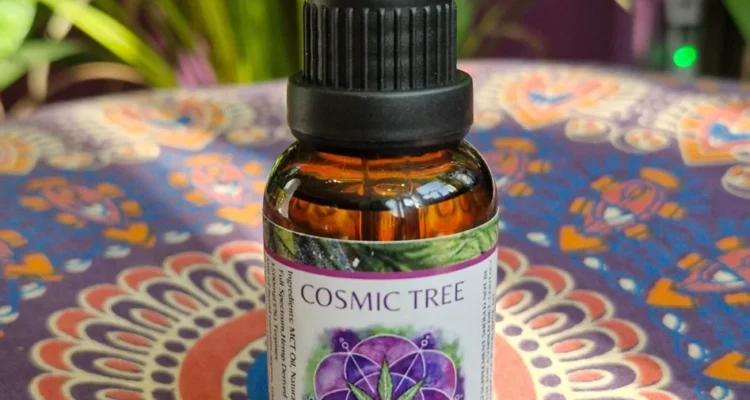
At Cosmic Tree we do not sell any CBD products to anyone under 18. If you look under the age of 25 we will ask to see your ID before selling a CBD Product to you.
Sources
- Misuse of Drugs Act 1971, section 37 (definition of cannabis) — legislation.gov.uk
- Misuse of Drugs Regulations 2001, regulation 2 (exempt product) — legislation.gov.uk
- Misuse of Drugs (Licence Fees) Regulations 2010, regulation 2 (the 0.2% figure) — legislation.gov.uk
- Home Office, Controlled drugs: industrial hemp — gov.uk
- Home Office, Industrial hemp licensing factsheet — gov.uk
- FSA, Cannabidiol (CBD) guidance — gov.uk
- FSA, CBD products linked to novel food applications — gov.uk
- FSA, the live public list — data.food.gov.uk
- ACNFP and COT joint position paper, provisional CBD acceptable daily intake, 12 October 2023 — gov.uk
- Human Medicines Regulations 2012, regulation 2 (definition of medicinal product) — legislation.gov.uk
- MHRA statement on products containing cannabidiol — gov.uk
- Single-use vapes ban guidance — gov.uk
- Tobacco and Vapes Act 2026, section 10 (sale to under-18s) — legislation.gov.uk
- Tobacco and Vapes Act 2026, section 50 (definitions) — legislation.gov.uk
- Tobacco and Related Products Regulations 2016 — legislation.gov.uk
This article explains what the regulations and regulator guidance say, and links to them throughout. It is general information, not legal advice, and the CBD rules change frequently. Businesses should take their own advice. Last reviewed 2 September 2026.